
Watermarks and Printers of Ottoman WWI Banknotes: A Comprehensive Correlation Study
☐ Background
The Ottoman Empire entered the 1st World War extremely short of funds.
The refusal of the Ottoman Imperial Bank (OTB) to issue a significant amount of paper money, and its abandonment of its monopoly on banknote issuance during wartime, forced the Ministry of Finance to choose a path it preferred to avoid: printing paper money.
The Ministry of Finance borrowed large sums of gold from Germany and Austro Hungary and used these loans as backing for the first issue of paper money in 1915. Following issues were backed by Treasury Bonds of the German and Austro Hungary governments, as Germany’s gold reserves were already under pressure and it became increasingly difficult for Germany to continue depositing gold for this purpose during the war.
☐ Banknote Printing Houses
Ottoman banknotes were printed mostly in Germany, with some also printed in Austria. Each printing house can be identified by the watermark used on its paper, as each printer employed its own distinct paper type. During this period, these printing houses also printed German banknotes. The Ottoman notes used only a few of these watermark types.
1) Giesecke & Devrient (G&D), Leipzig, Germany
G&D was the first and only printer, to deliver all of the first three banknote issues:
• Printed denominations below 1lira using paper bearing the GD-Hook watermark, which includes the embossed initials G and D.
• For the 1and 5 lira notes, paper baring the Fork watermark was used.
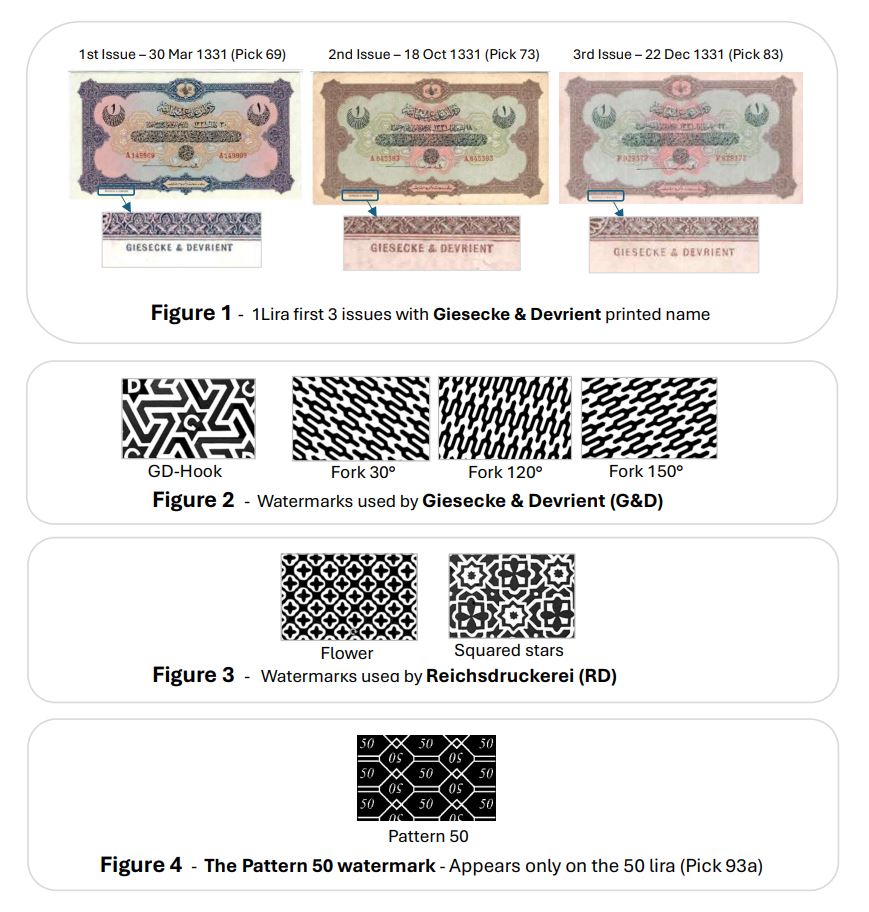
• In the first 3 issues of the 1 and 5 lira notes, the printer’s name appears clearly on the lower left of the front side (see Figure 1).
From the 4th issue and on, G&D stopped pranging its name on the note, as an additional printer house joined the production.
G&D used only the GD Hook and Fork watermark papers for all notes it printed. (see Figure 2)
The Fork watermark appears at different angles: 30°, 120°, or 150°. Depending on how the paper was fed into the printing machines. In some cases, different angles appear across prefixes of the same denomination of the same issue (see Figure 2).
2) Reichsdruckerei (RD), Berlin, Germany
RD joined as an additional major printer beginning with the 4th issue.
• Printed 20 kuruş, 1, 2½, 10 and 25 lira notes, using paper with the Flower watermark.
• Printed 50, 100 and 500 lira notes denominations, using paper with the Squared Stars watermark.
RD used only the Flower and Squared Stars watermark papers for all notes it produced. (see Figure 3)
3) Wiener Staatsdruckerei, Vienna, Austria
Wiener Staatsdruckerei joined only in the 4th issue.
• Printed 1 kuruş (Pick 85) and 2½ kuruş (Pick 86) notes.
These two notes are the only WWI ottoman banknotes printed without any watermark.
☐ WWI Banknotes Issues - Printers, Watermarks & Denominations
Issue 1 - 30 Mar 1331 Watermark Denominations
Giesecke & Devrient (G&D): Fork 1, 5 Lira
Issue 2 - 18 Oct 1331
Giesecke & Devrient (G&D): GD-Hook ¼ , ½ Lira
Giesecke & Devrient (G&D): Fork 1, 5 Lira
Issue 3 - 22 Dec 1331
Giesecke & Devrient (G&D): GD-Hook 5, 20 Kr & ¼, ½ Lira
Giesecke & Devrient (G&D): Fork 1 Lira
Issue 4a - 23 May 1332
Wiener Staatsdruckerei: No Watermark 1, 2½ Kr
Issue 4b - 6 Aug 1332
Giesecke & Devrient (G&D): GD-Hook 5, 20 Kr & ½ Lira
Giesecke & Devrient (G&D): Fork 1, 5 Lira
Reichsdruckerei (RD): Flower 1, 10Lira
Reichsdruckerei (RD): Squared stars 50, 500 Lira
Unknown Printer: Pattern 50 50 Lira
Issue 5 - 4 Feb 1332
Giesecke & Devrient (G&D): GD-Hook 5 Kr & ½ Lira
Giesecke & Devrient (G&D): Fork 1Lira
Reichsdruckerei (RD): Flower 20 Kr & 1, 2½, 10, 25 Lira
Reichsdruckerei (RD): Squared stars 100 Lira
Issue 6 - 28 Mar 1333
Giesecke & Devrient (G&D): Fork 5, 1000 Lira
Reichsdruckerei (RD): Flower 25 Lira
Reichsdruckerei (RD): Squared stars 100 Lira
Issue 7 - 28 Mar 1334
Reichsdruckerei (RD): Squared stars 100, 500 Lira
Issue 8 - 28 Mar 1334 (Em.1-6)
Giesecke & Devrient (G&D): Fork 5, 1000 Lira
Reichsdruckerei (RD): Flower 2.5,10, 25 Lira
Reichsdruckerei (RD): Squared stars 50, 100, 500Lira
Remark:
• Issues 1–7 were printed during the reign of Sultan Mehmed V Reşad.
• Issue 8 was printed during the reign of Sultan Mehmed
☐ Summery
A clear correlation exists between the printer of each Ottoman WWI banknote and the watermark used on its paper.
Giesecke & Devrient (G&D), Leipzig
• Printed all lower denominations from 5 kuruş to ½ lira (GD‑Hook watermark),
except the 20 kuruş (Pick 97, 4 Feb 1332), which was printed by RD.
• Printed all 5 lira and 1000 lira notes (Fork watermark).
Reichsdruckerei (RD), Berlin
• Printed all 2½, 10 and 25 lira notes (Flower watermark).
• Printed some of 50Lira notes and all 100 and 500 lira notes (Squared stars watermark).
• Printed the single low‑denomination: 20 kuruş (Pick 97).
Wiener Staatsdruckerei, Vienna
• Printed the 1 kuruş and 2½ kuruş notes (no watermark).
The 1 Lira Exception
• The 1 lira note was produced by two different printers, sometimes within the same issue:
• Issues 1 – 3: G&D only (Fork watermark).
• In Issues 4 – 5: Both G&D and RD:
- G&D (Fork watermark) – Pick 90a, pick 99a
- RD (Flower watermark) - Pick 90b, pick 99b
The Pattern 50 watermark (see Figure 4).
Appears only on the 50 lira – Pick 93a (Talat signature).
The printer is still unknown. likely G&D or RD. Further research is needed.
☐ Bibliography:
The Watermarks of the Ottoman Paper Money – By Samuel Lechman
Ottoman Banknotes Part I – By Samuel Lachman, IBNS Journal 12/5 (September), pages 280-285
Ottoman Banknotes Part II – By Samuel Lachman, IBNS Journal 12/4 (June), pages 217-226
Banknotes of Ottoman Empire – By Mehmet S. Tezcakin & Guclu Kayral, 2005, IBSN 975-00455-0-5
Ottoman Bank Notes 1840-1922 – By: Rafi Nachum, third Revision 1997
War Finance (Ottoman Empire) - By Ozan Ozavci
OttoCollect.com - Ottoman Empire banknotes Catalogue
Comments • 2
No comments yet. Be the first to comment!