☐ Background
The Ottoman Empire entered the 1st World War extremely short of funds.
The refusal of the Ottoman Imperial Bank (OTB) to issue a signific...
Watermarks and Printers of Ottoman WWI Banknotes: A Comprehensive Correlation Study
☐ Background
The Ottoman Empire entered the 1st World War extremely short of funds.
The refusal of the Ottoman Imperial Bank (OTB) to issue a significant amount of paper money, and its abandonment of its monopoly on banknote issuance during wartime, forced the Ministry of Finance to choose a path it preferred to avoid: printing paper money.
The Ministry of Finance borrowed large sums of gold from Germany and Austro Hungary and used these loans as backing for the first issue of paper money in 1915. Following issues were backed by Treasury Bonds of the German and Austro Hungary governments, as Germany’s gold reserves were already under pressure and it became increasingly difficult for Germany to continue depositing gold for this purpose during the war.
☐ Banknote Printing Houses
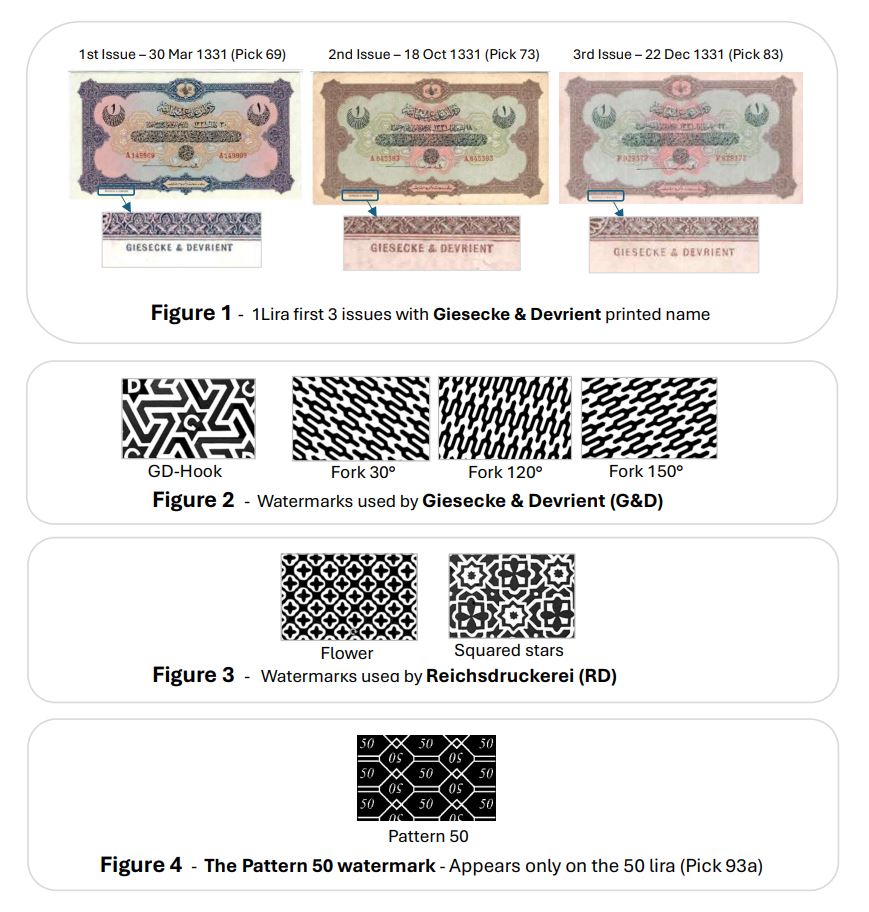
Ottoman banknotes were printed mostly in Germany, with some also printed in Austria. Each printing house can be identified by the watermark used on its paper, as each printer employed its own distinct paper type. During this period, these printing houses also printed German banknotes. The Ottoman notes used only a few of these watermark types.
1) Giesecke & Devrient (G&D), Leipzig, Germany
G&D was the first and only printer, to deliver all of the first three banknote issues:
• Printed denominations below 1lira using paper bearing the GD-Hook watermark, which includes the embossed initials G and D.
• For the 1and 5 lira notes, paper baring the Fork watermark was used.
• In the first 3 issues of the 1 and 5 lira notes, the printer’s name appears clearly on the lower left of the front side (see Figure 1).
From the 4th issue and on, G&D stopped pranging its name on the note, as an additional printer house joined the production.
G&D used only the GD Hook and Fork watermark papers for all notes it printed. (see Figure 2)
The Fork watermark appears at different angles: 30°, 120°, or 150°. Depending on how the paper was fed into the printing machines. In some cases, different angles appear across prefixes of the same denomination of the same issue (see Figure 2).
2) Reichsdruckerei (RD), Berlin, Germany
RD joined as an additional major printer beginning with the 4th issue.
• Printed 20 kuruş, 1, 2½, 10 and 25 lira notes, using paper with the Flower watermark.
• Printed 50, 100 and 500 lira notes denominations, using paper with the Squared Stars watermark.
RD used only the Flower and Squared Stars watermark papers for all notes it produced. (see Figure 3)
3) Wiener Staatsdruckerei, Vienna, Austria
Wiener Staatsdruckerei joined only in the 4th issue.
• Printed 1 kuruş (Pick 85) and 2½ kuruş (Pick 86) notes.
These two notes are the only WWI ottoman banknotes printed without any watermark.
☐ WWI Banknotes Issues - Printers, Watermarks & Denominations
Issue 1 - 30 Mar 1331 Watermark Denominations
Giesecke & Devrient (G&D): Fork 1, 5 Lira
Issue 2 - 18 Oct 1331
Giesecke & Devrient (G&D): GD-Hook ¼ , ½ Lira
Giesecke & Devrient (G&D): Fork 1, 5 Lira
Issue 3 - 22 Dec 1331
Giesecke & Devrient (G&D): GD-Hook 5, 20 Kr & ¼, ½ Lira
Giesecke & Devrient (G&D): Fork 1 Lira
Issue 4a - 23 May 1332
Wiener Staatsdruckerei: No Watermark 1, 2½ Kr
Issue 4b - 6 Aug 1332
Giesecke & Devrient (G&D): GD-Hook 5, 20 Kr & ½ Lira
Giesecke & Devrient (G&D): Fork 1, 5 Lira
Reichsdruckerei (RD): Flower 1, 10Lira
Reichsdruckerei (RD): Squared stars 50, 500 Lira
Unknown Printer: Pattern 50 50 Lira
Issue 5 - 4 Feb 1332
Giesecke & Devrient (G&D): GD-Hook 5 Kr & ½ Lira
Giesecke & Devrient (G&D): Fork 1Lira
Reichsdruckerei (RD): Flower 20 Kr & 1, 2½, 10, 25 Lira
Reichsdruckerei (RD): Squared stars 100 Lira
Issue 6 - 28 Mar 1333
Giesecke & Devrient (G&D): Fork 5, 1000 Lira
Reichsdruckerei (RD): Flower 25 Lira
Reichsdruckerei (RD): Squared stars 100 Lira
Issue 7 - 28 Mar 1334
Reichsdruckerei (RD): Squared stars 100, 500 Lira
Issue 8 - 28 Mar 1334 (Em.1-6)
Giesecke & Devrient (G&D): Fork 5, 1000 Lira
Reichsdruckerei (RD): Flower 2.5,10, 25 Lira
Reichsdruckerei (RD): Squared stars 50, 100, 500Lira
Remark:
• Issues 1–7 were printed during the reign of Sultan Mehmed V Reşad.
• Issue 8 was printed during the reign of Sultan Mehmed
☐ Summery
A clear correlation exists between the printer of each Ottoman WWI banknote and the watermark used on its paper.
Giesecke & Devrient (G&D), Leipzig
• Printed all lower denominations from 5 kuruş to ½ lira (GD‑Hook watermark),
except the 20 kuruş (Pick 97, 4 Feb 1332), which was printed by RD.
• Printed all 5 lira and 1000 lira notes (Fork watermark).
Reichsdruckerei (RD), Berlin
• Printed all 2½, 10 and 25 lira notes (Flower watermark).
• Printed some of 50Lira notes and all 100 and 500 lira notes (Squared stars watermark).
• Printed the single low‑denomination: 20 kuruş (Pick 97).
Wiener Staatsdruckerei, Vienna
• Printed the 1 kuruş and 2½ kuruş notes (no watermark).
The 1 Lira Exception
• The 1 lira note was produced by two different printers, sometimes within the same issue:
• Issues 1 – 3: G&D only (Fork watermark).
• In Issues 4 – 5: Both G&D and RD:
- G&D (Fork watermark) – Pick 90a, pick 99a
- RD (Flower watermark) - Pick 90b, pick 99b
The Pattern 50 watermark (see Figure 4).
Appears only on the 50 lira – Pick 93a (Talat signature).
The printer is still unknown. likely G&D or RD. Further research is needed.
☐ Bibliography:
The Watermarks of the Ottoman Paper Money – By Samuel Lechman
Ottoman Banknotes Part I – By Samuel Lachman, IBNS Journal 12/5 (September), pages 280-285
Ottoman Banknotes Part II – By Samuel Lachman, IBNS Journal 12/4 (June), pages 217-226
Banknotes of Ottoman Empire – By Mehmet S. Tezcakin & Guclu Kayral, 2005, IBSN 975-00455-0-5
Ottoman Bank Notes 1840-1922 – By: Rafi Nachum, third Revision 1997
War Finance (Ottoman Empire) - By Ozan Ozavci
OttoCollect.com - Ottoman Empire banknotes Catalogue
Within the family of 5 lira notes dated 28 March 1334 (1918), issued by the Ministry of Finance of the Ottoman Empire under Sultan Mehmed Vahdeddin, ...

When a “Unique” Ottoman Note Gets a Twin: 5 Lira 1918, 5th Emission, Series H
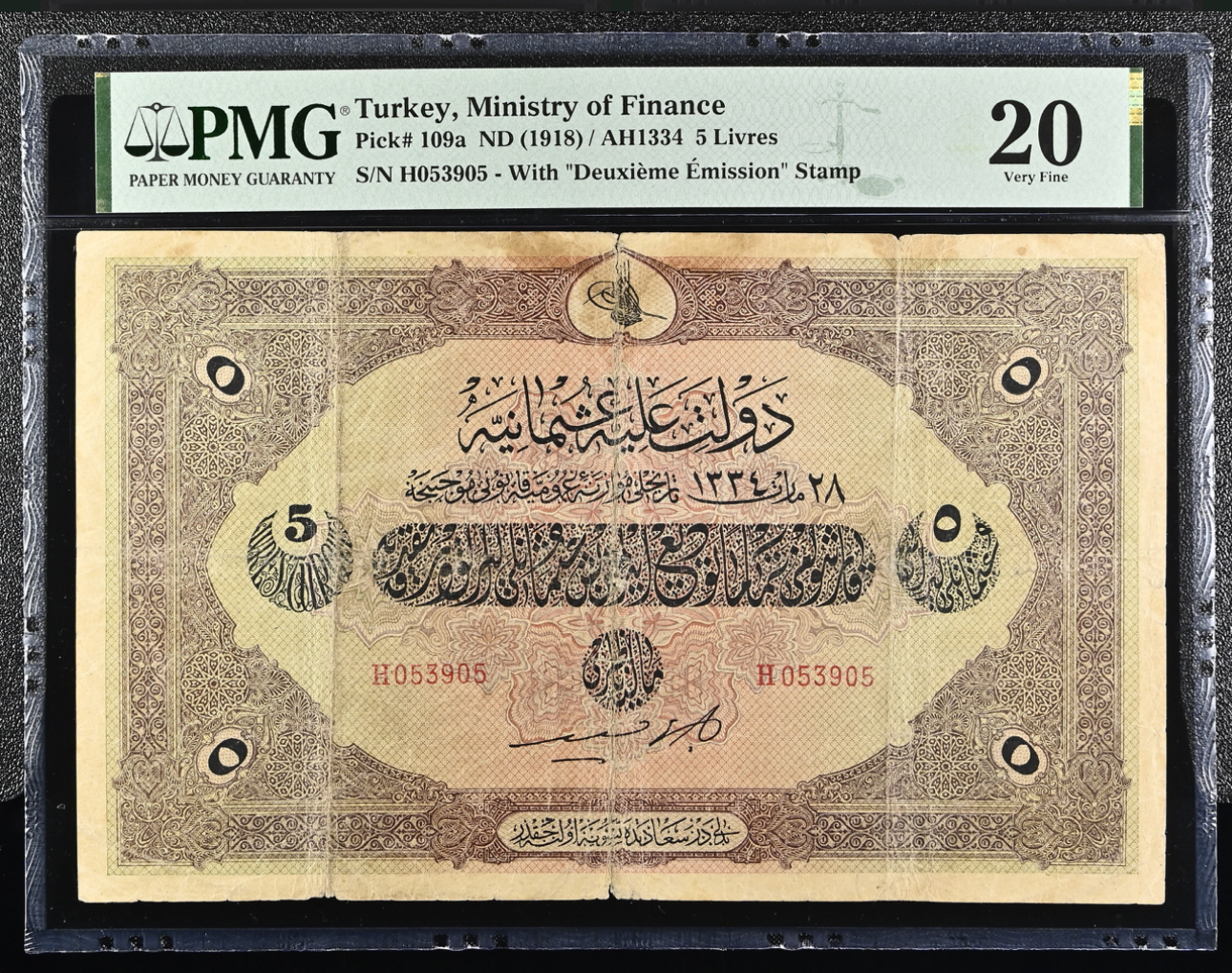
Within the family of 5 lira notes dated 28 March 1334 (1918), issued by the Ministry of Finance of the Ottoman Empire under Sultan Mehmed Vahdeddin, collectors usually distinguish several sub-types by the Emission stamp on the back. Among these, Pick 109b (with a 6th Emission stamp) is the relatively common type, while 109a, 109c and especially 109d are all very rare – with 109d regarded as the rarest of the group.
In the main Turkish catalogues of Ottoman paper money – first in the works of Mehmet S. Tezcakın & Güçlü Kayral and later in the updated catalogue by Kayral–Büyüktuncay–Uslu – this rare subtype appears as number 198 E-5 / VA-2 T3:
5 Lira, 28.03.1918, 5th Emission stamp, signatures Cavid (front) and Cahid (back), Series H only.
The online catalogue OttoCollect.com, today the most up-to-date digital reference for Ottoman notes, records this same subtype as Extended Pick 109d. For years, only one example of 109d was known and illustrated there – a circulation note with serial number H054350 – and in print it was effectively treated as “unique”.
Recently, however, a second note of exactly the same type has come to light. It is again a 5 lira of 28 March 1918 with a clear 5ᵉ EMISSION stamp, the same Cavid/Cahid signatures and the same Series H, but carrying a different serial number: H053905. This confirms that there are now at least two recorded examples of the 5th Emission, Series H:
• H054350 – the classic catalogue example;
• H053905 – a newly recorded note, scheduled to appear in public auction on 7 December 2025.
Following the documentation of H053905, the entry for Extended Pick 109d on Ottocollect.com has already been updated: the rarity status is no longer “Unique”, but RRRRR – still an extremely rare note, yet no longer a lone survivor.
For specialists in Ottoman paper money, this is a small but important adjustment to the rarity map of the 1918 5 lira series. It also illustrates how modern tools like Ottocollect, combined with careful recording of serial numbers by collectors, can quietly rewrite what we thought we knew about the scarcest issues of the late Ottoman Empire.
Introduction
In January 1840, the Ottoman Empire took a bold leap into the modern age of monetary policy with the issuance of its first paper currenc...
The First Kaime: The Birth of Interest-Bearing Banknotes in the Ottoman Empire (1840)
Introduction
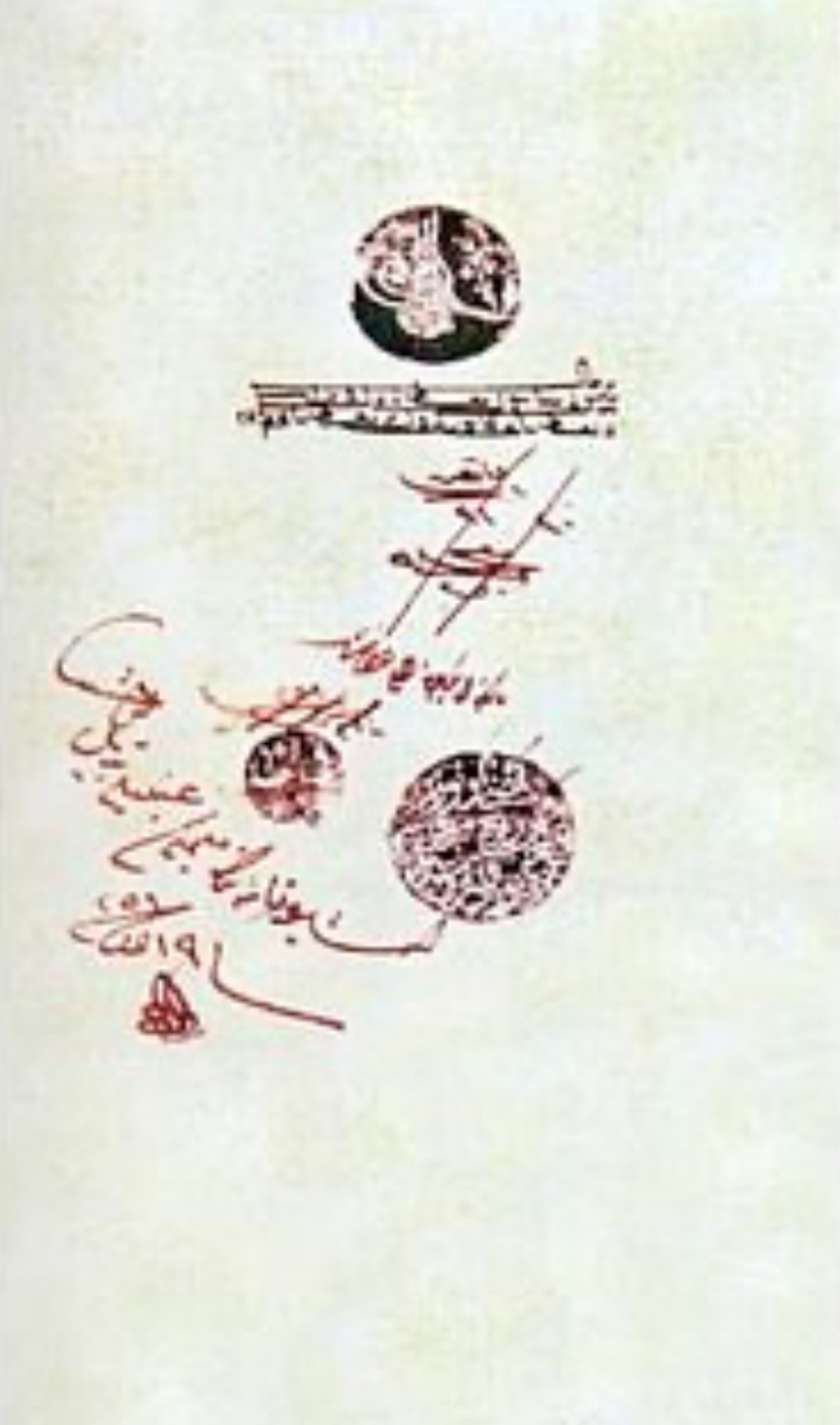
In January 1840, the Ottoman Empire took a bold leap into the modern age of monetary policy with the issuance of its first paper currency: the kaime-i nakdiyye-i mutebbere. Unlike traditional banknotes, these kaime were revolutionary for one key reason—they bore interest. This short-lived yet groundbreaking experiment marked one of the earliest examples of state-issued, interest-bearing money in global economic history.
This article delves into the origins, mechanisms, motivations, and legacy of the 1840 kaime, drawing on a blend of archival research and modern economic historiography.
⸻
Why 1840? The Tanzimat & a Treasury in Crisis
The kaime’s birth coincided with the launch of the Tanzimat reforms in 1839, a sweeping modernization effort aimed at reorganizing the Ottoman administrative, military, and financial systems. With reforms came massive state expenditures—but the Empire faced critical liquidity problems. Traditional borrowing from Galata bankers or foreign financiers proved insufficient or prohibitively expensive.
Faced with this fiscal bottleneck, the Ottoman government sought an internal solution. Thus, the kaime was introduced in 1840 as a form of state debt, circulating as paper money that would pay interest to the bearer—a hybrid between a treasury bond and a banknote.
🔍 Source: Pamuk, Şevket. Liquidity Preference and Interest-Bearing Money: The Ottoman Empire 1840–1851. Financial History Review, Vol. 11, Issue 1, 2004.
⸻
Design and Structure: Handwritten Notes with the Sultan’s Seal
The first kaime notes were handwritten, individually signed, and stamped with the tughra (imperial cipher) of Sultan Abdülmecid I. Printed on thick, durable paper, they came in denominations such as 500 kuruş, which at the time equaled roughly £4.5 sterling.
To ensure credibility, these notes were registered at the treasury, and were backed by the full guarantee of the state.
🔍 Source: Central Bank of Turkey Museum. History of Banknote Printing in the Ottoman Empire
https://sanalmuze.tcmb.gov.tr
⸻
The Interest Mechanism: An Innovative (and Risky) Proposition
What truly set these notes apart was their 12.5% annual interest rate, payable to the holder. The kaime would accumulate interest over eight years, and were redeemable through the treasury.
This structure made them function as interest-bearing debt instruments. Public confidence was bolstered by the interest feature, encouraging adoption in a society accustomed to coin-based transactions.
🔍 Source: Bulgarian National Bank Economic Review, “The First Interest-Bearing Banknotes in the Ottoman Empire,” 2005
https://www.bnb.bg/bnbweb/groups/public/documents/bnb_publication/pub_np_seemhn_02_05_en.pdf
⸻
Setting the Rate: Did the Empire Copy the West?
The Ottoman Treasury set the rate at 12.5% per annum, a figure not borrowed directly from European monetary systems but rather reflective of domestic borrowing costs. In fact, government borrowing from local financiers in Istanbul and the provinces often ranged between 12–15%.
Thus, while the kaime were inspired by Western notions of public credit, the interest rate was locally grounded.
🔍 Source: Pamuk, Ş. (LSE). “The Ottoman Economy and European Capitalism, 1820–1913.”
https://www.lse.ac.uk/Economic-History/Assets/Documents/Research/GEHN/GEHNConferences/conf6/Conf6-SPamuk.pdf
⸻
Circulation and Usage
Initially, the kaime circulated mostly in Istanbul and were accepted for tax payments, official salaries, and commercial transactions. They were treated as full legal tender, though they were always understood to represent a claim on future payment with interest.
While the interest followed the bearer, it was only paid at redemption. This meant that the person holding the note when it matured would collect the cumulative interest—not the previous owners. In the secondary market, notes sometimes traded at a premium or discount, reflecting their accrued value.
🔍 Source: Pamuk, Ş., Liquidity Preference and Interest-Bearing Money, 2004.
⸻
Coins vs. Kaime: Two Worlds, One Treasury
Unlike kaime, Ottoman coins (gold, silver) contained intrinsic value and did not yield any return. Kaime, on the other hand, represented a liability of the state—the first time Ottoman paper carried not only nominal value but time-based financial return.
This made the kaime particularly attractive in times of cash shortages, but also vulnerable to overissuance and inflation.
🔍 Source: Istanbul History Foundation. Finance in Ottoman Istanbul.
https://istanbultarihi.ist/571-finance-in-ottoman-istanbul
⸻
The Collapse: From Innovation to Devaluation
By 1844, new series were issued with a reduced interest rate of 6%, but the system ultimately buckled under the weight of war financing—particularly the Crimean War (1853–1856). The flood of new issues (to cover deficits) eroded public confidence. By the 1850s, kaime notes were trading at deep discounts, and the Empire ceased interest payments.
The government pivoted to non-interest-bearing banknotes and began efforts toward the founding of a central bank, leading to the eventual establishment of the Imperial Ottoman Bank in 1863.
🔍 Source: Bulgarian National Bank Review, 2005.
⸻
Legacy for Collectors
Today, the 1840 kaime are among the rarest and most historically significant Ottoman notes. Their combination of imperial authority, handwritten issuance, and built-in yield makes them a prized specimen in any collection.
Collectors should note the unique calligraphy, tughra marks, and condition of paper to assess authenticity and value. Surviving examples are typically housed in museum collections or elite private holdings.
⸻
Conclusion
The Ottoman Empire’s first kaime banknotes were more than just an early attempt at paper money—they were financial instruments designed to stabilize a reforming empire through public credit. While short-lived, they provide an extraordinary glimpse into the crossroads of Islamic finance, European modernization, and Ottoman innovation.
For collectors, historians, and economists alike, the kaime stand as both a technical marvel and a cultural milestone.